Introduction to Fajar Benua Group
FBI Group - Virtual Tour
Core product & services
Fajar Benua offers a wide portfolio of high-technology engineering products and services, including:
- Expansion joints, mechanical seals, fluoroplastic linings, advanced hoses, exotic metal pressure vessels.
- Related services such as stress analysis, installation, construction, troubleshooting, and emergency breakdown repair.
Organisational Strengths & Culture
Expansion into Digital & Consulting
In recent years, Fajar Benua Group has branched into digital innovation and consulting. Through initiatives like Fajar Benua Industries (FBI), their platform now includes:
- Digital manufacturing support: Services such as 3D scanning and stress analysis
- B2B marketplaces: A hybrid model combining e-commerce, digital financing, and integrated procurement solutions
- Consulting & tech services via PT Tekno Insan Mandiri
Challenges faced for growth
Due to its nature of traditional business, FBI group faced tremendous competition from digitalised established businesses and also innovative startups in supply chain domain.
The challenges listed below highlighted the urgency to find a viable solution.
Poor end-to-end visibility
Problem: No real-time view of inventory, work-in-progress, shipments or supplier status across sites and branches.
Impacted KPIs: Order cycle time, On-Time-In-Full (OTIF), stockouts.
Quick mitigation: Implement a centralised dashboard (even an interim Excel/Power BI integration) to consolidate key data feeds.
Inaccurate demand forecasting & planning
- Problem: Forecasts rely on manual guesses or stale spreadsheets → overstocking or stockouts.
-
- Impacted KPIs: Inventory turns, days of inventory, lost sales.
-
- Quick mitigation: Adopt basic demand-planning tools with rolling forecasts and seasonality adjustments.
-
High working capital tied in inventory
- Problem: Excess safety stock due to lack of trust in supplier lead-times and visibility.
-
- Impacted KPIs: Days Sales Outstanding (DSI) for inventory, cash conversion cycle.
-
- Quick mitigation: Vendor-managed inventory pilots for critical SKUs and visibility agreements.
Long lead times & slow responsiveness
Problem: Manual purchase orders, slow approvals and poor supplier coordination delay fulfilment.
Impacted KPIs: Lead time, customer lead time, fill rate.
Quick mitigation: Automate PO creation for recurring buys and establish SLAs with top suppliers.
Fragmented data silos and duplication
Problem: Sales, procurement, warehouse, engineering and service teams use separate systems/spreadsheets → inconsistent master data.
Impacted KPIs: Forecast accuracy, error rates, rework costs.
Quick mitigation: Create a single source of truth for SKU master data and part numbers.
Low procurement efficiency & higher cost of goods
Problem: Manual RFQs, missed volume discounts, reactive spot buys.
Impacted KPIs: Cost per unit, procurement cycle time, % savings vs. benchmark.
Quick mitigation: E-procurement portal for preferred suppliers and simple spend analytics.
Poor supplier risk management
Problem: No automated supplier scorecards, limited early warnings on supplier distress or capacity changes.
Impacted KPIs: Supplier defect rate, disruption frequency, contingency response time.
Quick mitigation: Tier suppliers by criticality and run quarterly performance reviews; require simple KPIs from top 20 suppliers.
Service/after-sales delays & poor field parts availability
Problem: Field teams can’t locate critical spares quickly → longer downtime for clients.
Impacted KPIs: Mean time to repair (MTTR), service SLAs, customer satisfaction (CSAT).
Quick mitigation: Mobile parts lookup + reserved field kits for top service calls.
Compliance, traceability & audit challenges
Problem: Hard to produce traceability reports for materials, certifications, and installation records.
Impacted KPIs: Audit turnaround time, compliance incidents, warranty claims.
Quick mitigation: Digitise certificates and attach them to SKU records; use QR/barcode scanning for traceability.
Reactive maintenance planning
Problem: No predictive maintenance feeds from equipment → emergency repairs and high repair costs.
Impacted KPIs: Maintenance cost per unit, unplanned downtime.
Quick mitigation: Start with condition-based checks and digitised logs; pilot IoT on highest-value assets.
Limited pricing agility & inability to run scenario analysis
Problem: Manual costing prevents rapid tender responses or dynamic pricing for contracts.
Impacted KPIs: Gross margin, bid win rate, response time.
Quick mitigation: Build a cost calculator (spreadsheet → simple app) that factors in lead times and freight.
Talent & change-management gaps
Problem: Staff resist new tools or lack skills for digital workflows; transformation stalls.
Impacted KPIs: User adoption rate, project ROI, time to value.
Quick mitigation: Run rapid upskilling workshops plus “super-user” champions in each branch.
Introduction to Blitznet
Founded in 2021 by Mr. Juan Jose, Mr. Akshesh Panchal and Mr. Mrugesh Panchal, Blitznet is an Indonesia-based B2B super-platform connecting buyers and suppliers of raw materials, semi-manufactured, and manufactured goods headquartered in Jakarta. Its aim is to simplify procurement, logistics, and financing for industrial supply chains across the country.
Core Offerings & Features
RFQ Management: Buyers post requests for quotes (RFQs) with product specs, quantities, and terms, receiving offers from vetted suppliers—all within a streamlined interface.
Group Buying: Buyers can join forces via Digital Buyers Groups to pool demand, benefit from volume pricing, and unlock cash-back incentives upon successful procurement.
End-to-End Supply Chain Support
- E-Procurement Tools with AI/ML-powered demand planning and stock visibility
- Payment & Fintech Services: Use of escrow, working capital support, and bill discounting
- Logistics Integration: Track-and-trace capabilities, and partnerships with logistics providers for seamless delivery
- Trust Network: A platform fostering secure and reliable relationships between buyers and suppliers
FBI acquired Blitznet
To address the challenges of operating through traditional methods, FBI decided to acquire Blitznet and transition its human-driven operations to a fully digital supply chain management suite.
Post acquisition, all Blitznet's founders actively involve in all strategic and daily operation to achieve entire new milestone for the group.
We are thankful to Mr. Pande Kadek and entire FBI team for their belief in our team and product.
The transaction comprises an all-equity swap worth more than $15 millions.
Following are the few of the historic moments & starting of the new journey for the group.
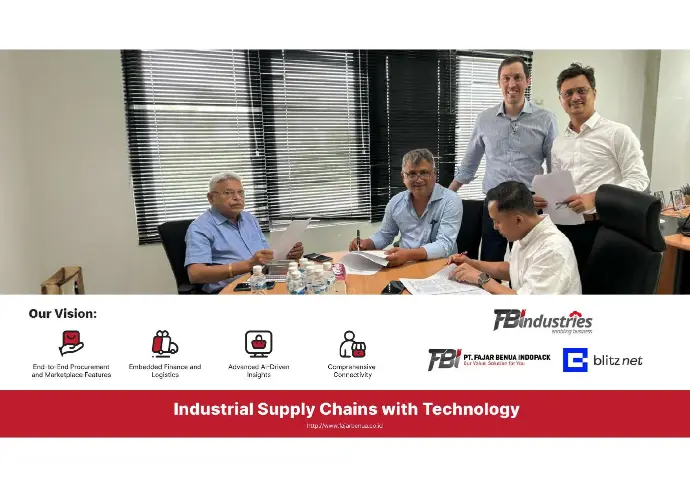
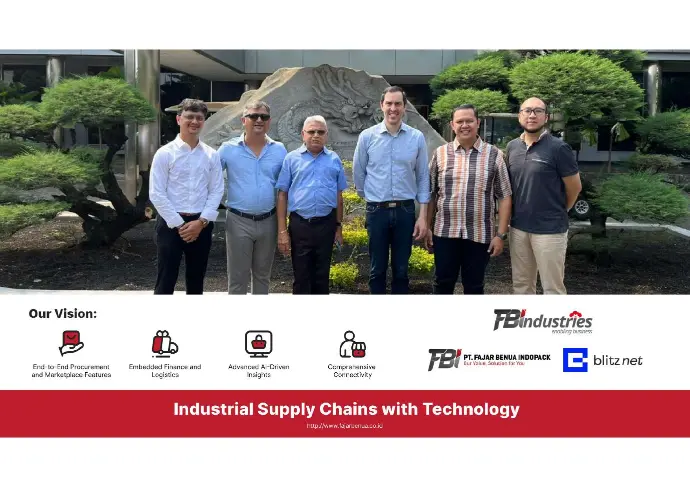
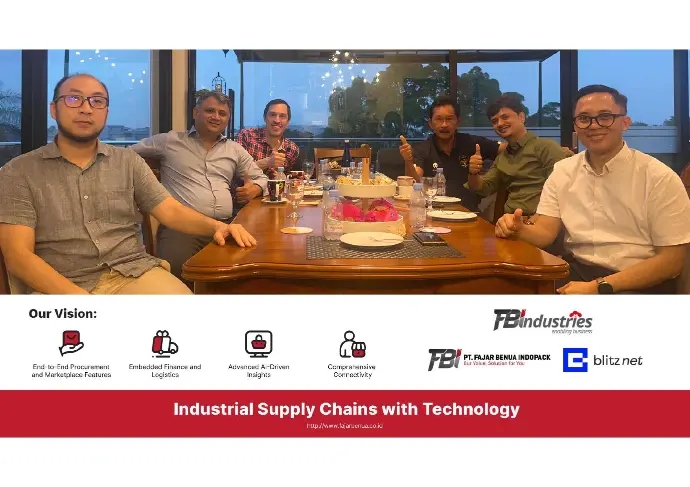
FBI has announced this acquisition publicly in Dec - 2024 and since then process has already started to merge both companies.
Global Recognition
FBI acquired Blitznet in Dec-24 to start transforming themselves just from a legacy manufacturing company to a digital trading platform serving over 2000+ clients.
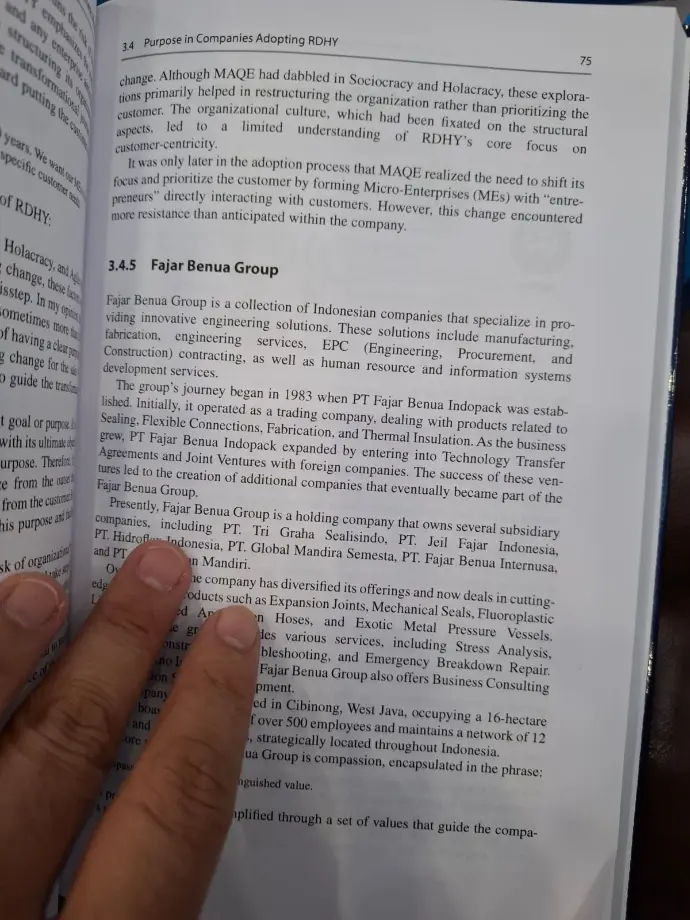
Our transformation story is also featured as a case study in the book authored by Haier’s founder, Mr. Zhang Ruimin — further validating our belief in the future of digital supply chains.
Proudly sharing that Fajar Benua Industries has been recognized as one of the Best Transformed Companies in adopting the Rendanheyi Model from Haier Group — alongside global leaders like Bayer AG and GE Appliances worldwide.
Rendanheyi is the system that change our culture and how we work, where our employee have their freedom and spirit to grow.
This is not just an award, but a validation of our vision. The journey has just begun — and we’re excited for the road ahead!